On 30 July 2026 in Brussels, Japan signed its association agreement with Horizon Europe. This is the largest economy ever to join a European research framework programme, and the world’s third largest economy now plays by the same rules as a Ukrainian university.
For the Ukrainian research community this is not an abstract item of Brussels news. Japan ranks among Ukraine’s largest donors, yet its money has travelled through government channels and passed researchers by. Now a mechanism exists where a Ukrainian institution and a Japanese laboratory sit in the same consortium and both draw funding from the EU budget. Below you will find what changed, why Japan wanted it, why Brussels wanted it, and what a Ukrainian organisation can take from it.
What exactly was signed on 30 July
Takashi Hamada, Japan’s Deputy Ambassador to the EU, and Maria Cristina Russo, Deputy Director-General of the European Commission’s Directorate-General for Research and Innovation, signed the agreement. It closes a process that ran for more than half a year, because the two sides concluded negotiations back on 22 December 2025.
Formally, Japanese organisations have worked inside the programme since January 2026 under transitional arrangements. They already applied to calls and were already assessed as eligible participants from an associated country. So the signature on 30 July gave that practice full legal backing rather than starting the process.
Japan’s association covers Pillar II of Horizon Europe. This is the largest part of the programme, worth 52.4 billion euros, and it funds large collaborative projects across six clusters: health; culture, creativity and inclusive society; civil security for society; digital, industry and space; climate, energy and mobility; and food, bioeconomy, natural resources, agriculture and environment.
Why association means something different from cooperation
Japan cooperated with the EU on science well before this. The Science and Technology Cooperation Agreement has run since 2011, and several thematic dialogues operate alongside it, among them the EU-Japan Enhanced Dialogue on Advanced Materials launched on 2 April 2024, the Digital Partnership, and the Broader Approach agreement on fusion energy.
Three things now differ. First, a Japanese institution can coordinate a project rather than join one as an invited guest. Second, it draws money from the EU budget directly, because the old requirement to secure parallel domestic funding simply to sit in a consortium has gone. Third, and least obvious, association opens access to the programme’s governance structures, which means influence over how future work programmes take shape. Japan is therefore a co-author of the rules rather than a user of the calls.
Why Japan wanted this
The simplest answer, money, happens to be the wrong one. Japan contributes financially to the programme like every other associated country, so that its researchers can draw funding from it. This buys a ticket rather than collecting a subsidy.
The real motive lies elsewhere. Japanese science has been strong and closed at the same time for decades: high publication quality, weaker international co-authorship than European peers, limited researcher mobility. Horizon Europe is the world’s largest machine for enforced cooperation, since funding requires a consortium spanning at least three countries. For Japanese universities this buys a network that bilateral memoranda cannot build.
The second motive is thematic. The areas both sides name as shared read like a list of Japanese industrial priorities: advanced materials, semiconductors, biotechnology, artificial intelligence, quantum computing, renewable energy and fusion technology. In each of those Japan holds an industrial base and needs a market and a regulatory environment so that its work does not stay domestic.
The third motive is geopolitical, and people rarely say it out loud. Research cooperation with China grows harder for Tokyo because of export control regimes and dual-use concerns. Europe looks like the safer alternative with predictable rules.
Why the EU wanted this
Horizon Europe is turning from a European programme into a global one, and that shift is deliberate. According to the European Commission, by the end of March 2026 the programme had 22 associated countries outside the EU. Japan’s signature makes 23. Meanwhile the EU formally opened negotiations with Australia, concluded exploratory talks with India, and put the Morocco process on hold.
The logic is simple. Europe loses to the United States and China on private research investment, so it builds advantage where it can: on openness and partner count. Once Canada, New Zealand, South Korea and now Japan enter the programme, the EU effectively assembles a coalition of research-heavy democracies around its own rules of the game.
Budget context matters too. In its proposal for the next long-term EU budget covering 2028 to 2034, the Commission wants to double the programme to 175 billion euros. The more associated countries contribute their own money and bring their own laboratories, the easier that number becomes to defend before member states.
Find open Horizon Europe calls that fit your profile
GetGrant updates its programme database daily and shows which Pillar II clusters your organisation can enter as a partner or a coordinator.
Who is already in the programme
Association comes in different depths. Some countries reach the whole programme, including European Research Council grants and European Innovation Council instruments, while geographically distant partners enter Pillar II only. Ukraine sits in the first group, so it holds broader access than Japan does.
| Group | Countries | Depth of access |
|---|---|---|
| European area and neighbourhood | Norway, Iceland, Switzerland, United Kingdom, Faroe Islands, Ukraine, Moldova, Georgia, Armenia, Israel, Türkiye | Whole programme. For the UK the EIC Accelerator fund is the exception |
| Western Balkans | Serbia, Montenegro, North Macedonia, Albania, Bosnia and Herzegovina, Kosovo | Whole programme |
| Mediterranean and Africa | Tunisia, Egypt | Whole programme |
| Distant partners | Japan, South Korea, Canada, New Zealand | Pillar II only |
| In negotiation | Australia, India, Morocco | No association status yet |
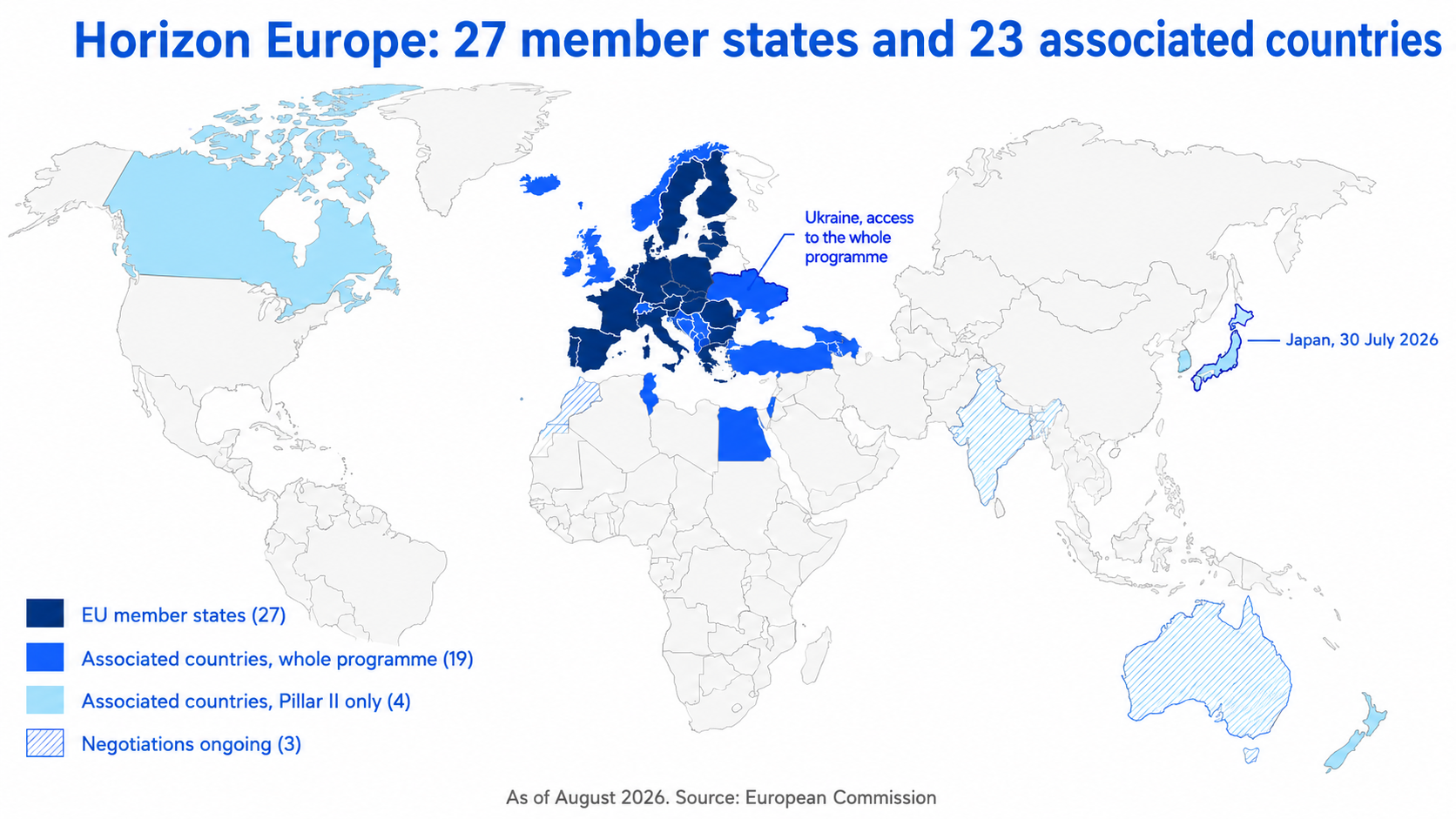
The Commission keeps the current list with its legal wording in a separate document that it updates several times a year. Participation statistics for each country sit in the country profiles on the Commission’s site.
What this gives Ukrainian organisations
The point here is to avoid overstating the effect while still catching the real opportunity.
The mechanics work like this. Ukraine is associated to the whole programme, Japan to Pillar II. Where those two statuses overlap is Pillar II itself, meaning collaborative projects across the six clusters. Inside that overlap a Ukrainian institution can coordinate a consortium and invite a Japanese partner, and both sides receive EU funding. Before January 2026 that configuration did not exist, because a Japanese partner either arrived with its own money or did not arrive at all.
Where the interests actually meet
The strongest joins appear where Japanese expertise answers a Ukrainian need, rather than where the buzzwords happen to match.
- Infrastructure resilience and disaster response. Japan holds the deepest practical experience anywhere in restoring critical infrastructure after destruction and in early warning systems. That belongs to the climate, energy and mobility cluster and to civil security for society.
- Rehabilitation and prosthetics. Ukrainian need here runs into the hundreds of thousands of people, while Japanese robotics and materials science supply the technological half. Health cluster.
- Advanced materials and semiconductors. Both Tokyo and Brussels named this a shared priority, and Ukrainian technical universities keep strong schools in the field. Digital, industry and space cluster.
- Energy resilience and distributed generation. Japan rebuilt its energy system after 2011, while Ukraine rebuilds its own under fire. The topic stays applied and legible to both sides.
- Agri-food systems. The food and bioeconomy cluster, where Ukrainian production scale meets Japanese processing and quality control technology.
There is one practical entry point: the Funding and Tenders portal and its partner search inside a specific topic. Japanese organisations appeared there as eligible participants from January 2026, so the database is already filling up.
Looking for Horizon Europe consortium partners
GetGrant experts will assess how your project fits a call topic, match it to a Pillar II cluster, and help you build the partner configuration.
A sober look at the limits
Pillar II is the hardest part of Horizon Europe for a newcomer. A consortium submits the proposal, which demands an experienced coordinator, a detailed split of work packages and a budget planned years ahead. Success rates across most topics run below 15%, and a strong proposal takes three to six months to prepare.
The second limit concerns Japan itself. Its association does not extend to European Research Council grants, European Innovation Council instruments or Marie Skłodowska-Curie funding. Japanese researchers can still take part on the general terms for third countries, though that is a different legal regime. So proposals along the lines of ‘let us run a joint ERC project with the Japanese’ do not work the way they sound.
The third limit is ours. Ukrainian institutions mostly enter Horizon Europe as partners rather than coordinators, and they rarely assemble consortia themselves. Japan’s arrival does not fix that. It only widens the list of people you can call once you already know how to build a consortium.
What to do next
If your organisation already holds a project idea under one of the six clusters, a Japanese partner is now a realistic element of the configuration rather than an exotic one. Start from the call topic instead of the partner: find the topic first, then look at whose expertise covers the weak spot in your consortium.
If no project idea exists yet, the most useful move is to read which Pillar II topics open in the 2027 work programme and judge where your institution can own a work package rather than merely join one. That distinction separates a consortium that wins from a consortium that merely assembled.
One closing thought, more about direction than procedure. Over the past two years Canada, New Zealand, South Korea, Switzerland, Egypt and now Japan entered the programme, with Australia and India next in line. Horizon Europe is ceasing to be a European programme and becoming a global research infrastructure with European rules. Ukraine got inside that infrastructure earlier than Japan did, and so far only a handful of institutions use the advantage.
Track Pillar II topics as they open
Set up your organisation profile, and GetGrant will alert you to new Horizon Europe calls in your thematic clusters.