Many grant applications get written in a single night before the deadline. The team submits at 23:50, the budget is thrown together in a hurry, and half of the required attachments turn up an hour before the call closes. Three months later a rejection arrives over a formal issue that could have been fixed in five minutes, if only there had been time.
This scenario repeats every month. A grant manager or a civil society organisation learns about a call 3 days before it closes, and then the race against the clock begins. Grant systems do not forgive haste, because they penalise it at the level of their own rules, before an expert even reads the first page of your project.
Below we break down why haste damages even strong applications, how much time quality preparation actually takes, and how to build a deadline monitoring system so you never write a project in the last night again.
See every open grant and its deadline in one calendar
GetGrant updates its database of programmes for NGOs, researchers and businesses every day. Filter by deadline, topic and region, and let AI matching surface calls that fit your profile, instead of hours of manual portal monitoring.
The last-night syndrome is a systemic problem
When you have only 3 days for an application, your brain switches to survival mode. The team focuses on submitting at all, so quality of argument drops. This is exactly where the mistakes a funder spots instantly begin to appear.
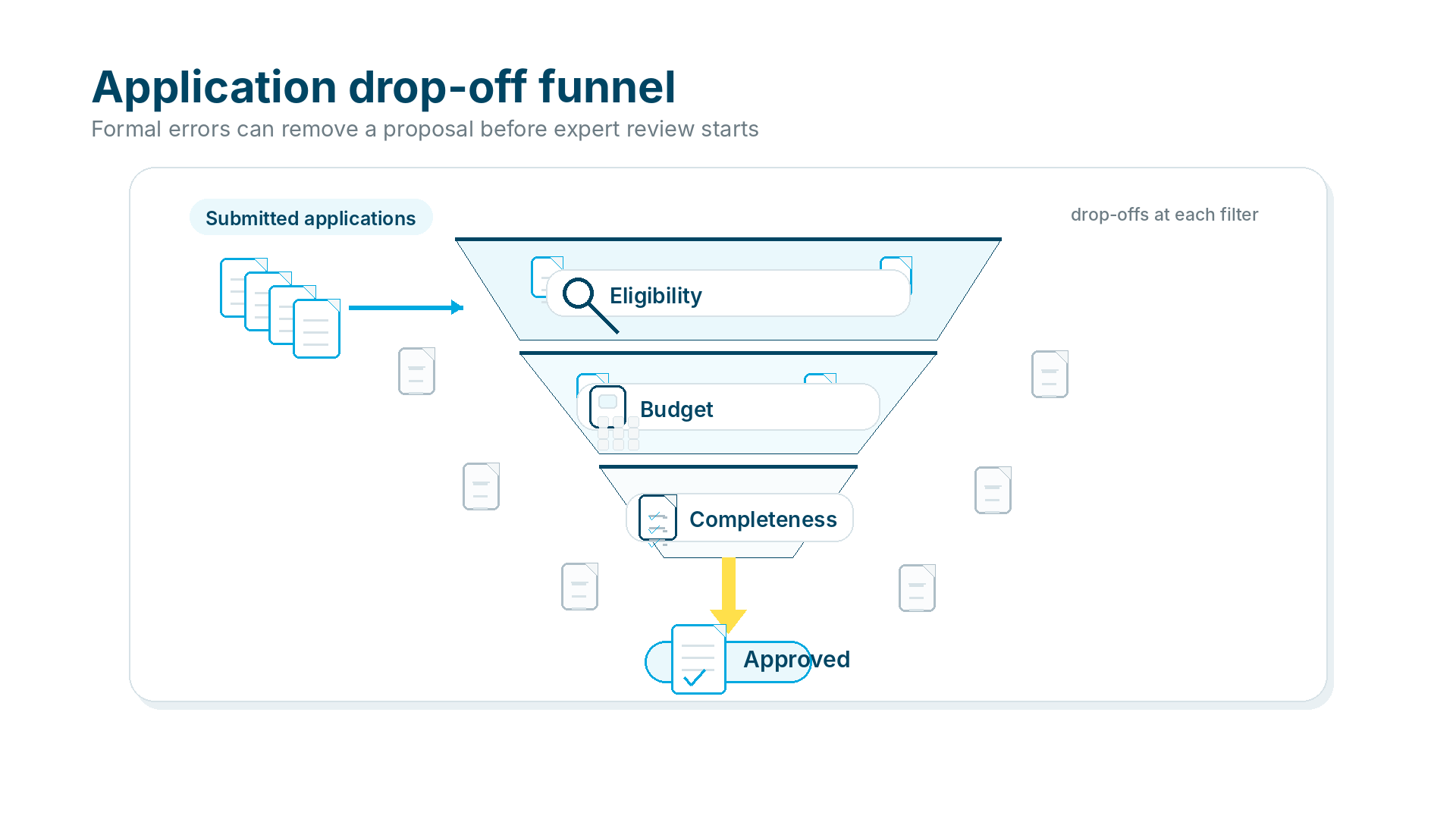
Most rejections happen even before a weak idea matters. According to sector analysts, roughly 30 to 40% of applications are screened out before evaluation because they fail formal requirements: a missing document, the wrong organisation type, an incorrect file format. The expert never even reaches the project description.
In large programmes, competition makes the cost of a mistake even higher. The average success rate in Horizon Europe stands at around 15.9%, so 7 out of 10 quality applications get rejected simply because the budget cannot fund everyone. When a call is this crowded with strong projects, any carelessness made in haste pushes your application into the bottom half of the ranking automatically.
Figures from the US sector show the same pattern. In NIH programmes during fiscal year 2025, 87% of applications went unfunded. Some of them lost specifically because of avoidable mistakes that a normal preparation schedule would have caught.
How much time a quality applications really needs
The gap between perception and reality here is huge. It feels like an application can be written in one evening. The practice of grant teams says otherwise.
For complex European programmes, successful consortia start preparing the project 4 to 6 months before the deadline. Writing the narrative itself takes 6 to 10 weeks of active work, and that excludes partner coordination, budget alignment and internal review. A full submission for a large project can cost several hundred hours of team work.
Even small and simplified schemes need time. In a study of the Australian AusHSI programme, where the submission process was cut to a minimum, applicants spent 7 days on average preparing their proposal. Seven full days of work, even when the funder deliberately stripped the form down to the essentials.
Why competition leaves no room for haste
The oversubscription rate in Horizon Europe is about 4.7. To fund every submitted project, the programme budget would have to grow almost 5 times. Under that pressure, an application thrown together overnight competes against projects that took half a year to prepare.
For research grants, the overall rejection rate sits at 80 to 90%. The conclusion is simple: the draft project should be finished well before the deadline, because the final weeks are what separate a strong application from an average one.
What haste breaks first
When time runs short, three things suffer, and the fate of the application depends on all three: eligibility, the budget, and formal completeness. Let us go through each.
Eligibility and business activity codes
For business grants, some programmes require specific activity codes, a minimum operating history, a particular registration type, or a sector match. Checking these criteria takes time that panic mode does not have. As a result, a company prepares an application for a grant it does not qualify for on a formal point, and finds out only after the rejection.
A quick eligibility check before any work saves weeks. So experienced teams run a short go or no-go analysis as the very first step, before they even open the application form.
Check whether your profile fits a specific grant
60 minutes with a GetGrant expert: a review of the call requirements, your activity codes and organisational profile, and an assessment of your real chances before you spend weeks on preparation. Write to support@getgrant.ua.
A budget thrown together in a hurry
Budget errors rank among the most frequent causes of low scores. The most common ones: figures in the budget do not match the project description, arithmetic slips, forgotten cost categories, and unrealistic amounts. An expert reads this as a signal that the team has not thought the delivery through.
If your narrative promises 10 events but the budget covers the cost of three, the reviewer spots the gap at once. On a calm schedule, the budget gets checked against the text several times. The night before submission, that check usually gets skipped.
Formal completeness
A missing letter of support, the wrong file format, exceeding a character limit, an empty required field, a missing signature. Each of these small things can pull an application out of review automatically, because many portals run a software completeness check.
A basic sector recommendation: submit your application at least 48 hours before the deadline, so you keep time for technical portal failures. In last-night mode that buffer does not exist, and when the portal freezes an hour before closing, there is no way to save the application.
Preparation timeline: panic mode versus system mode
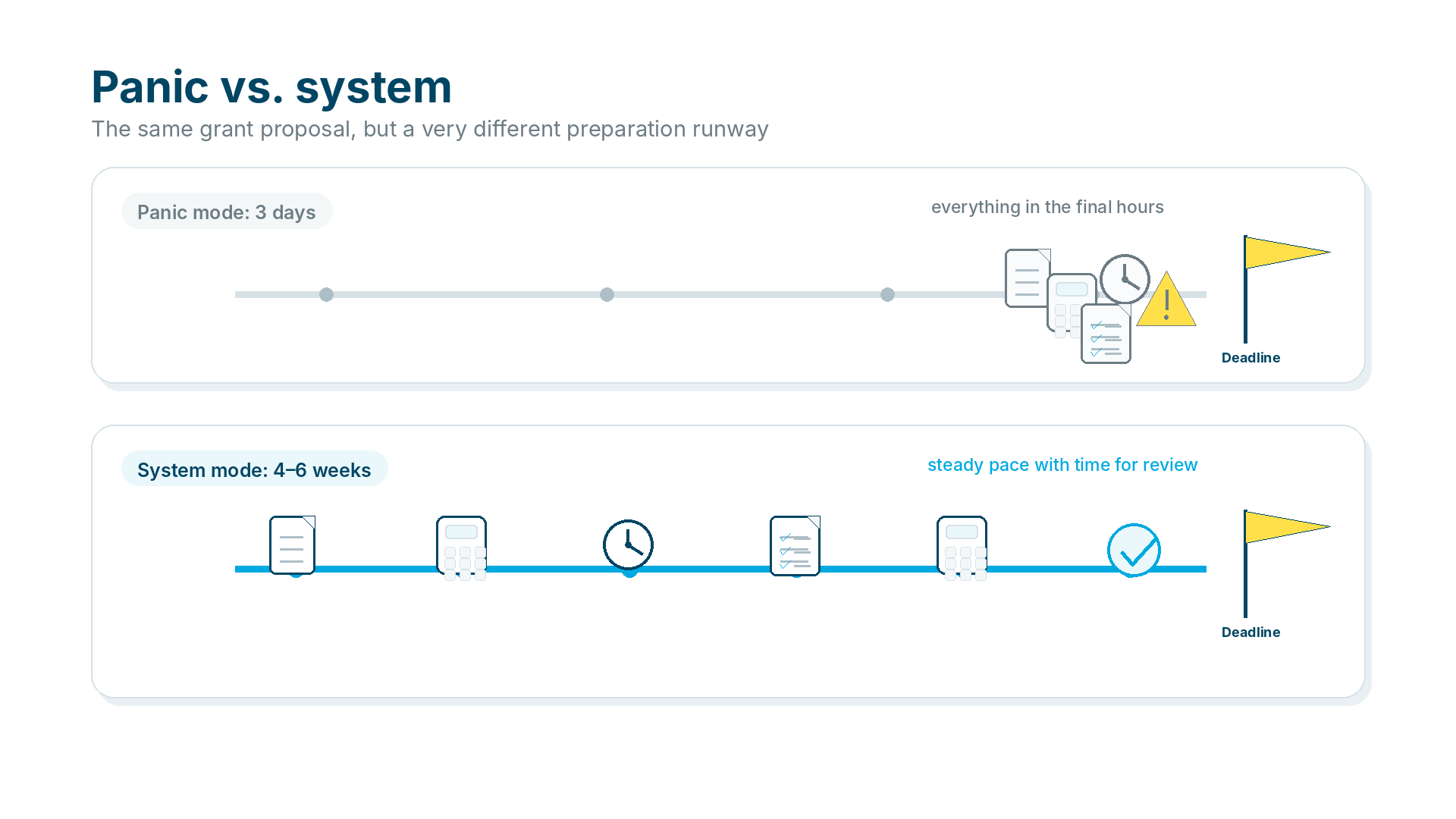
The same application goes through the same stages in both modes. The difference is how much attention each step gets. Here is what preparing a mid-sized project looks like when you have 3 days versus when you have 4 to 6 weeks.
| Preparation stage | Panic mode (3 days) | System mode (4 to 6 weeks) |
|---|---|---|
| Eligibility check | A quick glance, with the risk of applying for the wrong grant | A full review of requirements and profile before work starts |
| Project concept | The first draft goes straight to submission | Time to refine and align with the team |
| Partners and support letters | Often impossible to gather in time | Requested 2 to 3 weeks early, collected calmly |
| Budget | Pulled together fast, with no check against the text | Budget reconciled with the narrative several times |
| Internal review | Skipped entirely | A fresh pair of eyes proofreads before submission |
| Submission | At 23:50, risking a portal freeze | 48 hours before the deadline, with a buffer for failures |
Indicative timing for a mid-sized project. For large consortium applications, system mode stretches to 4 to 6 months.
How to build a grant monitoring system
The root of last-night syndrome is one thing: people learn about a grant too late. When information about a call arrives in time, you get the same 4 to 6 weeks that quality preparation needs. So monitoring matters more than writing the text itself.
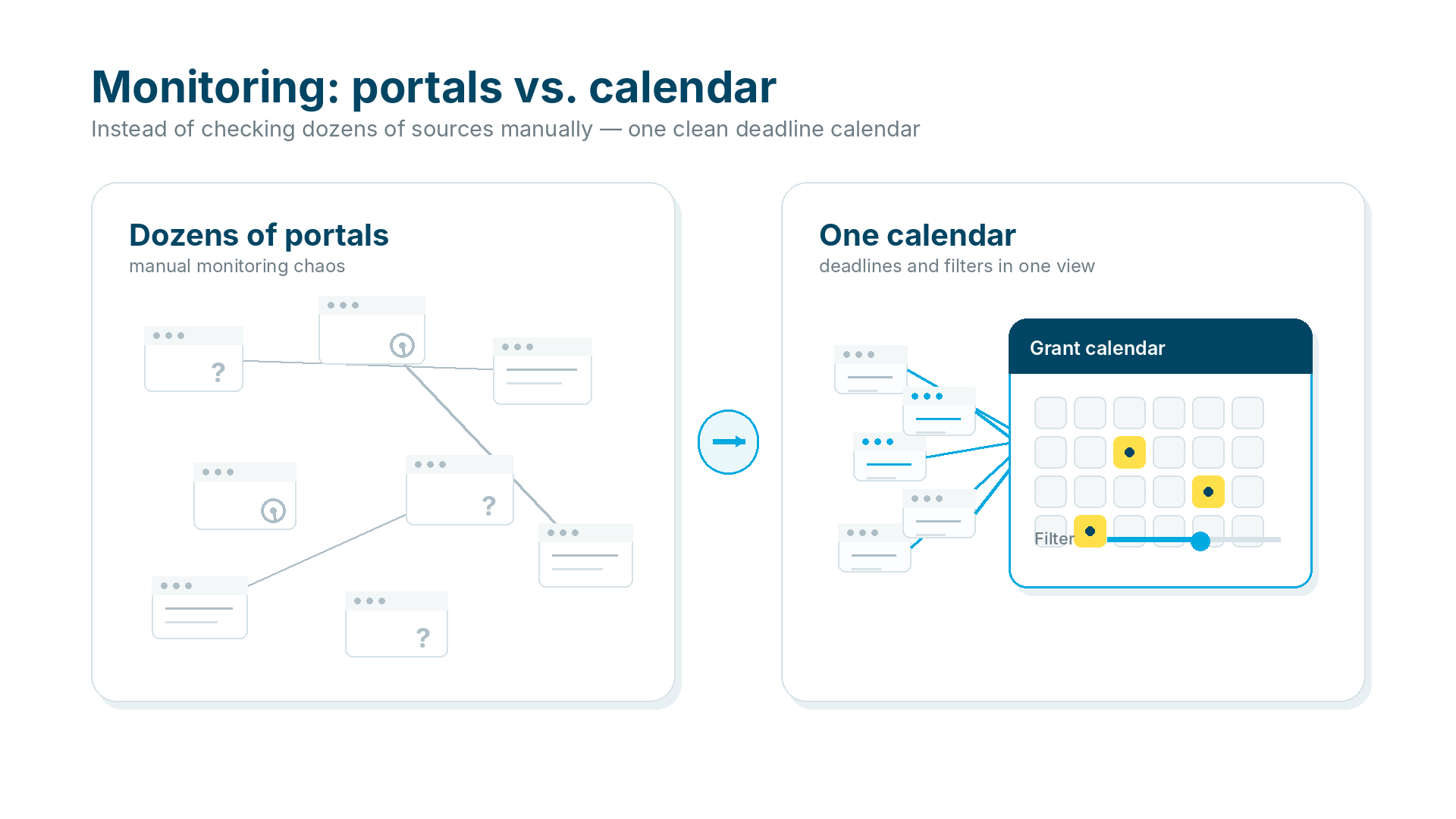
Manual monitoring has two weak points. First, there are many programmes, and they are scattered across dozens of donor portals, each with its own calendar. Second, free aggregators often show outdated data, so a team prepares for a call that has already closed, or misses one that quietly opened a week ago.
What a working system should do
A working monitoring system handles several jobs at once. It collects current deadlines in one calendar, filters programmes by topic, region and submission window, and matches calls to your organisation profile, screening out the irrelevant ones. So you see what you need at once, without checking dozens of sites.
This is exactly the work GetGrant does. The database of programmes updates daily, AI matching maps open calls to your profile, and the deadline filter shows what closes soon and where there is still a buffer for preparation. Instead of manually checking portals, you get a list of relevant grants with clear dates.
A subscription to such a service saves the main resource that panic mode lacks: time. When you learn about a grant a month ahead rather than 3 days ahead, you gain 3 to 4 weeks of lead time for normal project preparation. That is the difference between an application pulled from review over a formal error and one that reaches expert evaluation.
What to do after
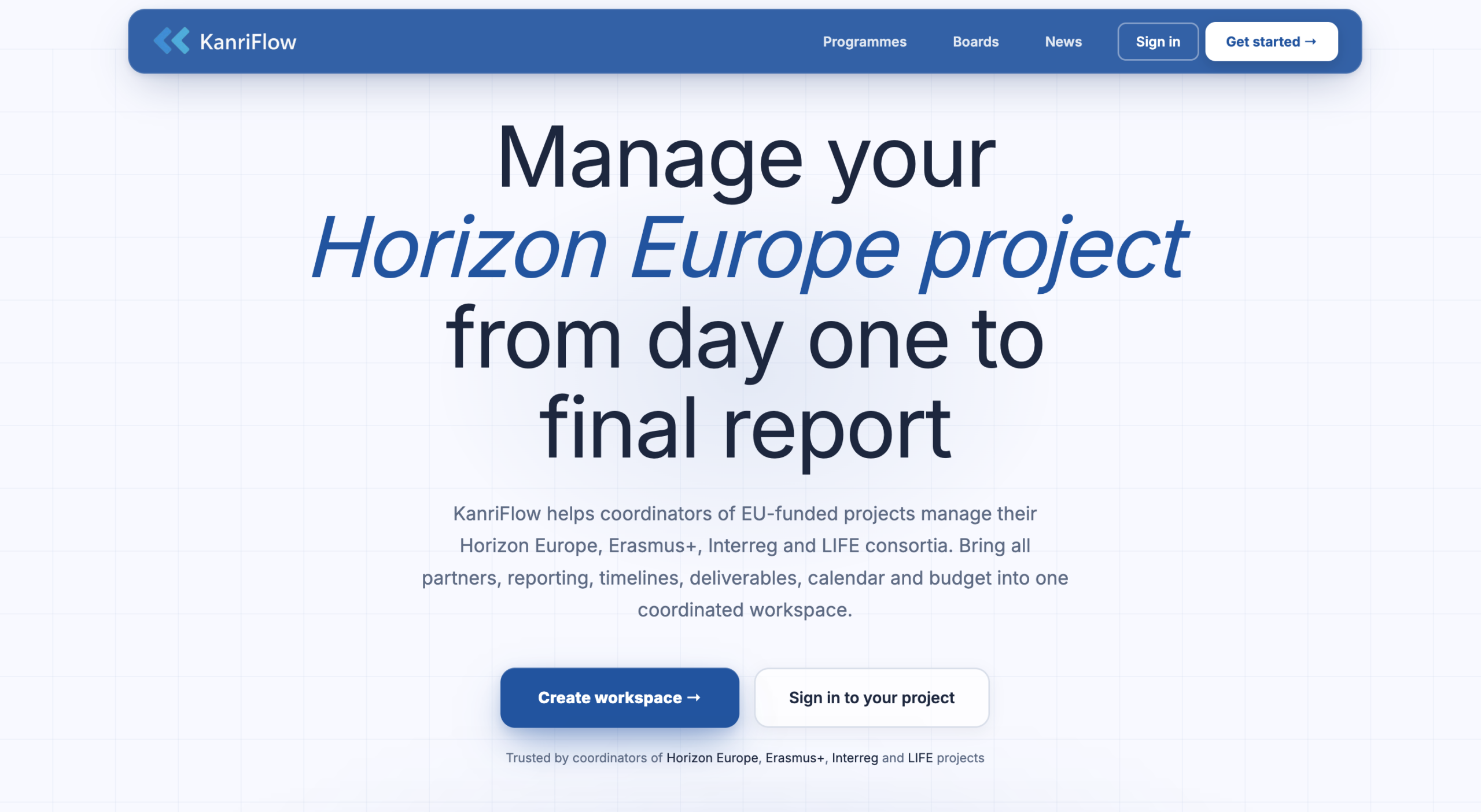
A systematic approach keeps working after the application is submitted. Once you win the grant, an equally demanding stage begins: planning the work, reporting, and tracking deadlines across work packages and the budget. This is exactly what KanriFlow does, a platform for coordinators of EU-funded projects in Horizon Europe, Erasmus+, Interreg and LIFE. It brings a 48-month Gantt, periodic reporting (Annex 4 and Annex 5), deliverable and deadline tracking, budget control following Horizon Europe tables, and a risk register into one workspace. The same order that saves your time before the deadline keeps the project under control through the months of work that follow.
Stop learning about grants 3 days before the deadline
GetGrant tracks deadlines for you and gives you 3 to 4 weeks of lead time for quality preparation. We give back the time you spend on manual portal search.