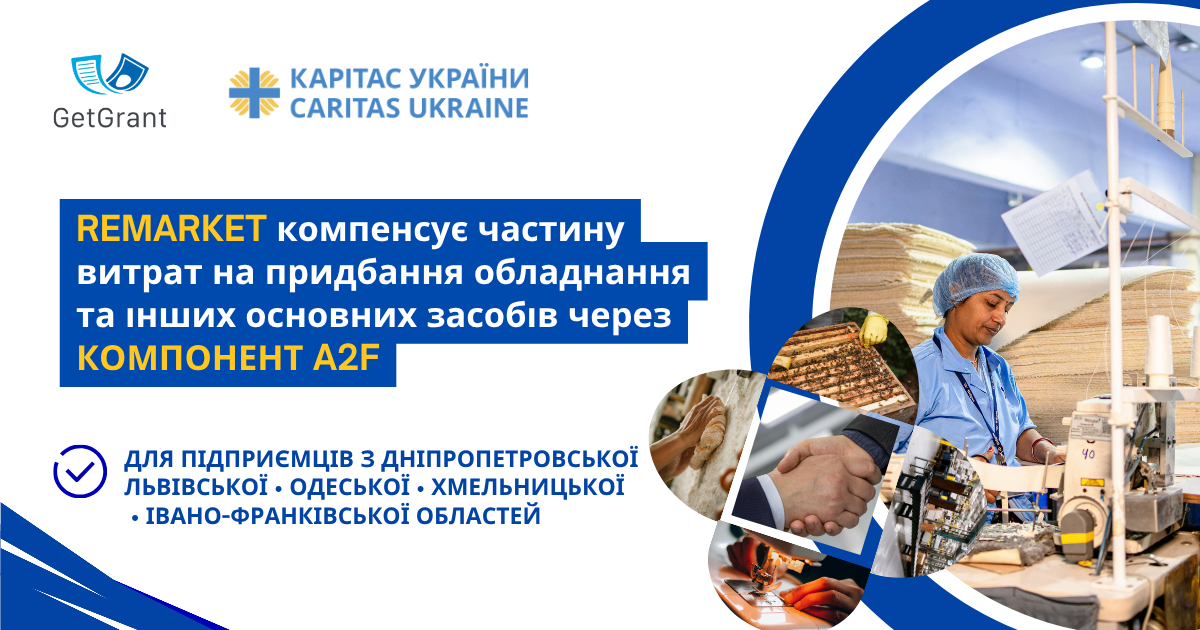
Micro, small and medium enterprises in five Ukrainian regions can recover up to 10% of an investment loan, capped at CHF 10,000. That compensation comes from a new component of the REMARKET project called Access to Finance, or cash-back grants.
The logic runs in reverse compared with a classic grant. A company first takes a loan from the partner bank to buy fixed assets, spends the money strictly on the agreed purpose and documents every purchase. Only after those documents pass verification does the project compensate part of the investment cost.
One date deserves separate attention, 1 September 2026. Until then 20% of the cash-back budget is reserved exclusively for enterprises that already received grant support within REMARKET. After that date the unused balance may be redistributed among other companies that meet the programme conditions.
Business calls in one place
FundingHub by GetGrant: EU programmes, bilateral donors and state instruments matched to your company profile, with confirmed deadlines.
What a cash-back grant is and how it works
A cash-back grant is a financial incentive for mature enterprises that could in principle access bank financing, yet still face financial barriers to investing. The component exists to lighten the load on a business that is ready to scale and treats a loan as its next step.
The mechanism has three steps. The company takes an investment loan from the partner bank, buys fixed assets from the list of eligible items, then submits the paperwork and claims compensation of up to 10% of the loan amount.
No loan, no compensation. This is not direct funding received before the investment, and it is not an alternative to a loan. If the bank declines the credit application, the enterprise cannot claim the cash-back grant. Choosing a different bank does not work either, because the loan has to come from the project partner bank.
The REMARKET project pays the grant, not the bank. The decision sits with the project, taken through the local Caritas network in the target regions, provided the applicant meets the programme conditions.
Who can apply
An applicant has to meet all of the following conditions at once:
- registered in Ukraine and trading for at least 6 months;
- an operating and financially stable business;
- registered in Odesa, Dnipropetrovsk, Khmelnytskyi, Ivano-Frankivsk or Lviv region;
- working in garment production, beekeeping, baking or selected innovative cross-sector models;
- planning to invest in development and raising loan financing to buy fixed assets.
A mandatory parameter on the bank side. Official annual turnover of the borrower must not exceed EUR 50 million, or total balance sheet must not exceed EUR 43 million, and the number of officially registered employees must stay below 250. This is the standard SME definition the bank applies when assessing an application.
The programme does not fit businesses that cannot obtain a bank loan, have been trading for less than 6 months, fall outside the defined sectors, or intend to spend the money on anything other than fixed assets. There is no cap on repeat participation by one business, although each case is assessed separately within the programme budget.
Previous grantees come first. For enterprises that already received REMARKET grants, 20% of the cash-back budget is reserved until 1 September 2026.
| Parameter | Details |
|---|---|
| Programme | REMARKET, Access to Finance component (cash-back grants) |
| Implemented by | Caritas Switzerland with Caritas Ukraine, Caritas-Spes Ukraine and SPARK |
| Donors | SDC and the If Foundation, supported by Caritas Austria, Cordaid and Trócaire |
| Who applies | Micro, small and medium enterprises trading for at least 6 months |
| Sectors | Garment production, beekeeping, baking, innovative cross-sector models |
| Regions | Odesa, Dnipropetrovsk, Khmelnytskyi, Ivano-Frankivsk, Lviv |
| Compensation | Up to 10% of the loan amount, maximum CHF 10,000 |
| Payout currency | Hryvnia, at the rate on the payment date |
| Partner bank | Raiffeisen Bank JSC, no other bank qualifies |
| Minimum loan | From CHF 20,000 in equivalent |
| Loan term | Up to 60 months, grace period of up to 12 months possible |
| Eligible use | Fixed assets only, vehicles and working capital excluded |
| Document deadline | Preferably 15 days after the loan, 6 months at the latest |
| Payout time | Usually up to 2 months after a complete document package |
| Priority | 20% of the budget reserved for REMARKET grantees until 1 September 2026 |
| Primary source | REMARKET programme page on the partner bank website |
Loan terms at the partner bank
Raiffeisen Bank JSC provides the loan financing. The main parameters look like this:
- amount from CHF 20,000 in equivalent;
- term of up to 60 months;
- grace period of up to 12 months possible;
- collateral defined by the bank, which may include movable property, guarantees or other instruments;
- the credit decision follows the bank standard borrower assessment procedures.
So the credit half of this instrument lives by banking rules: financial history, solvency assessment, collateral. The REMARKET project does not intervene in that decision and does not guarantee it.
What the loan money can buy
The money goes exclusively to fixed assets used in the production or operational activity of the enterprise. Costs must be of an investment nature, meaning they raise production capacity, efficiency or scale. Eligible assets:
- production equipment, machinery and technological lines;
- specialised machinery;
- equipment for food, textile, cosmetic and pharmaceutical production;
- equipment for beekeeping and product processing;
- electronic and innovative equipment;
- warehouse and logistics equipment;
- office and IT equipment;
- energy efficient and green solutions;
- other specialised assets directly linked to the activity of the enterprise.
Vehicles are not financed. The ban covers every type of transport: trucks, vans, pickups, specialised vehicles including refrigerated ones, and also trailers and semi-trailers.
Working capital stays outside the programme too. Salaries, raw materials and supplies, services, rent, utilities and other current operating costs do not qualify for compensation. If the loan is used outside its intended purpose, the cash-back claim will not be considered.
Which documents are needed and when
To confirm that the investment happened, the enterprise submits documents on the purchase and payment of the assets:
- invoices, receipts and contracts;
- payment documents and proof of payment;
- supplier documents;
- photographs of the purchased equipment;
- financial and tax reporting.
The submission window. Documents should preferably arrive within 15 days after the loan is received, and the maximum term is 6 months. Anything submitted later will not be considered.
Applications are also limited by the programme budget. Once it is exhausted, intake may close early even if the formal deadline has not arrived yet. Therefore planning should follow budget availability rather than the calendar.
Payout, monitoring and grounds for refusal
Payment comes in hryvnia at the rate on the payment date, usually within two months after a complete document package is submitted. That window covers both the verification and the transfer.
Nothing is guaranteed. Receiving the loan does not by itself mean the compensation will be approved. A refusal can follow from failure to meet the criteria, buying assets outside the eligible list, spending outside the intended purpose, or an incomplete or incorrect document package. Refusal remains possible after the loan has already been drawn.
What gets checked afterwards. The partner bank runs a post-payment check, usually after 6 months. No formal reporting is required from the business, although declarative reporting applies: the presence and use of the equipment is verified, and the project collects basic indicators, headcount and enterprise revenue after the investment.
The project maintains a zero tolerance policy towards corruption and abuse, abuse of power, discrimination on any grounds, and sexual exploitation and violence. Separate feedback channels exist for reporting violations.
Where to apply
The cash-back claim goes through the partner bank that issued the loan. Participation conditions and lending parameters are published on the REMARKET programme page of Raiffeisen Bank JSC, where a request for a lending consultation can also be left.
Questions about the programme itself, sector eligibility and documents are better addressed to the local REMARKET team in your region:
- Dnipropetrovsk region, Caritas Donetsk charitable foundation in Dnipro: ov.basan_donetsk@db.caritas.ua
- Lviv region, Caritas Lviv UGCC charitable foundation: elislvivcaritas@gmail.com
- Khmelnytskyi region, Caritas Khmelnytskyi UGCC charitable foundation: remarket.khm@gmail.com
- Odesa region, Caritas Odesa UGCC charitable foundation, 4/6 Komitetska street, Odesa: remarket@caritas.od.ua
- Ivano-Frankivsk region, Caritas Kolomyia charitable foundation: karitas.kolomya@gmail.com
About the REMARKET project
REMARKET, or Recovery and Empowerment through Market Access and Resilient Economic Transformation in Ukraine, is a three-year initiative implemented by Caritas Switzerland in partnership with Caritas Ukraine, Caritas-Spes Ukraine and SPARK. Funding comes from the Swiss Agency for Development and Cooperation (SDC) and the If Foundation, with support from international partners of the Caritas network: Caritas Austria, Cordaid and Trócaire.
The project aims to strengthen resilience and earning opportunities in beekeeping, the garment industry and baking through support for micro, small and medium businesses. Selected enterprises receive grants, business development services and better access to finance, so the cash-back grant is only one instrument in that set.
The component suits enterprises that already run a stable business and plan to buy equipment, modernise production or expand operational capacity, yet want to reduce the financial load of a loan. For a business not yet ready for bank financing, this instrument will not work.
Not sure you meet the criteria
GetGrant experts check your company profile against the programme conditions and help assemble the document package for the compensation.
Check which other calls fit you
The GetGrant database shows EU programmes, bilateral donors and state instruments by company profile, with confirmed deadlines.