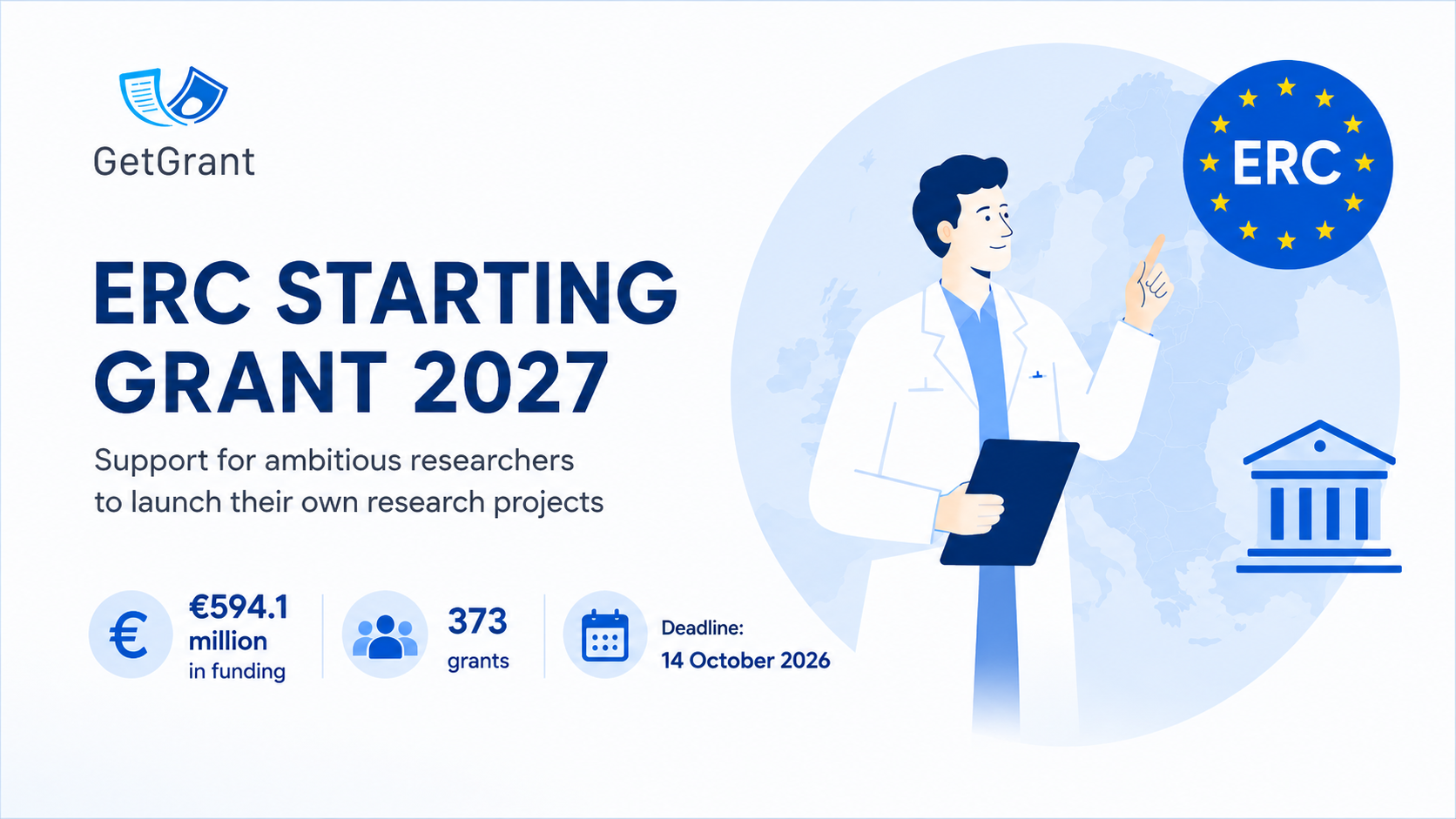
594.1 million euro and 373 grants. That is what the European Research Council (ERC) set aside for the ERC Starting Grant 2027 call, which opened on 22 July 2026. The deadline falls on 14 October 2026.
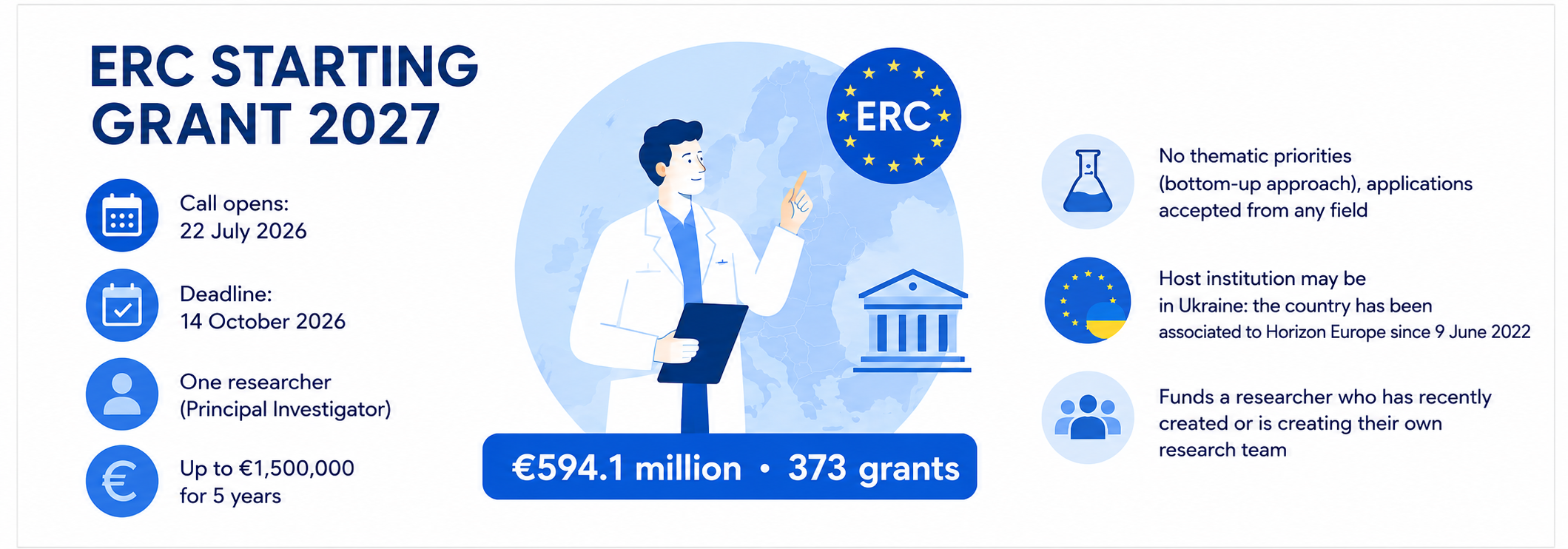
One researcher, up to 1,500,000 euro over 5 years, and no preset topics. The host institution can sit in Ukraine, because the country has been associated to Horizon Europe since 9 June 2022 and takes part in the programme on the same terms as EU Member States.
The 2027 ERC Work Programme also changes the main access rule. Specifically, the eligibility window after the PhD defence widens from 2 to 7 years out to 0 to 10 years. As a result, two large groups of researchers who could not apply last year can apply now.
Find open grants that match your research field
GetGrant updates its database daily, from Horizon Europe to bilateral fellowships. AI matching instead of hours of manual search across portals.
What opened on 22 July
The ERC Starting Grant funds a researcher who has just built, or is building, an independent research team. The call identifier is ERC-2027-StG. A single Principal Investigator submits the proposal on behalf of the host institution and then carries responsibility for the scientific side of the project.
There are no thematic priorities, because the ERC works bottom-up: you bring the idea, and the panel judges it against excellence as the sole criterion. Proposals from any field qualify, including interdisciplinary ones.
How much money, and for what
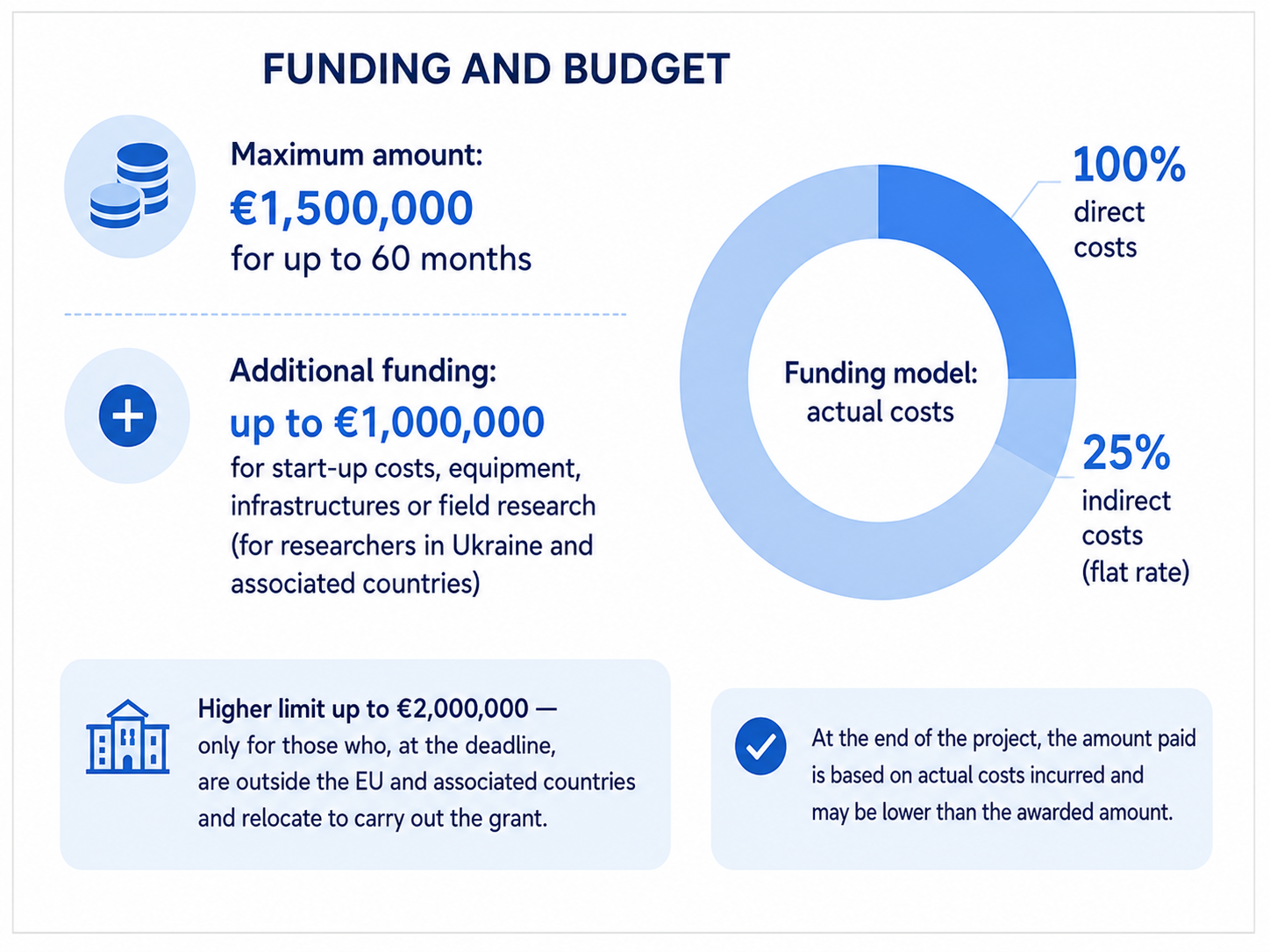
The grant reaches 1,500,000 euro for up to 60 months. Beyond that ceiling, applicants can request additional funding of up to 1,000,000 euro for start-up costs, major equipment, access to large facilities, or expensive field work. Each request needs justification in the proposal, since the panel assesses it as well.
One detail gets misread often. The higher ceiling of 2,000,000 euro applies only to researchers based outside the EU and associated countries at the call deadline who relocate to take up the grant. Ukraine is an associated country, so a researcher working at a Ukrainian institution falls under the general ceiling of 1,000,000 euro.
The funding model uses actual costs. In practice, the ERC reimburses 100% of direct costs plus a flat 25% for indirect costs. At the end of the project the payment rests on the costs actually incurred, so it can come in below the awarded amount.
The main 2027 change: a 0 to 10 year window after the PhD
Until this year the Starting Grant was open to researchers 2 to 7 years past their defence. The 2027 Work Programme removes the lower bound and lifts the upper one to 10 years.
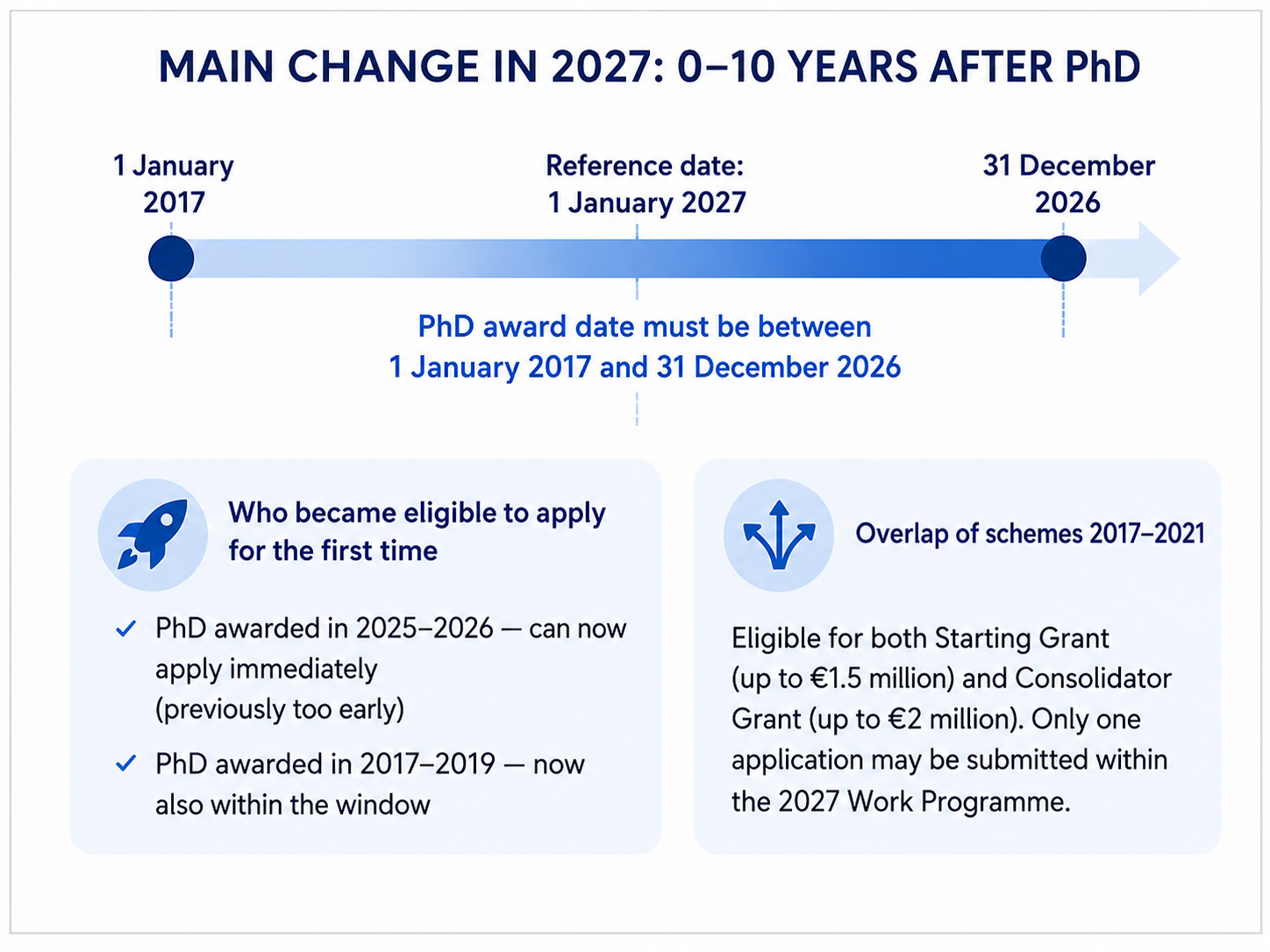
The exact dates work like this. To apply to ERC-2027-StG, the successful defence of your first PhD or an equivalent doctoral degree must fall between 1 January 2017 and 31 December 2026, counted against a cut-off date of 1 January 2027.
Who can apply for the first time
First group: researchers who defended in 2025 and 2026. Under the old rule they counted as too early and had to wait two years. Now they can apply straight away.
Second group: those who defended in 2017, 2018 and 2019. Under the old rule the 2027 window would have covered defences between 1 January 2020 and 31 December 2024 only. Now those three years sit inside it.
The ERC explains the change by pointing to how differently academic careers develop across countries and disciplines. A mathematician and a biologist reach research independence at different ages.
That produces an overlap worth planning around. The Consolidator Grant 2027 window covers defences between 1 January 2012 and 31 December 2021, so anyone who defended between 2017 and 2021 now qualifies for both schemes at once: the Starting Grant with a ceiling of EUR 1.5 million and the Consolidator Grant with a ceiling of EUR 2 million. You will have to pick one, because the 2027 Work Programme allows a single eligible proposal.
Extending the window: what counts
Documented circumstances extend the window. Maternity leave adds 18 months per child, and where the actual leave ran longer, the full duration counts. Paternity and parental leave add the documented amount. Long-term illness beyond 90 days, national service, disability and clinical training of up to 4 years extend it too.
Two further provisions matter for Ukrainian researchers. First, the Work Programme treats major disasters as large-scale events including armed conflicts that cause loss of life or property. If a researcher could not work for at least 90 days because of such an event, the window extends by that documented period.
Second, seeking asylum counts. The extension runs from the date of the asylum application to the decision on refugee status or the receipt of a residence permit. Both extensions need paperwork, so start collecting documents months ahead.
Why the 2027 competition gets harder
The Starting Grant 2026 call drew 4,807 proposals, which was 22.4% more than the year before, and that earlier call had itself grown by 13%. Against those 4,807 proposals the ERC planned around 450 grants, so roughly 9 applications in 100 stood a chance of funding.
In 2027 the number of grants drops to 373. If applications merely hold at last year’s level, the arithmetic puts the success rate near 8%. We ran that arithmetic ourselves, since the ERC publishes no official success-rate forecast. The direction it points in is clear enough.
The new limits on submissions
The ERC Scientific Council answered the rising volume with restrictions. These are the ones that affect the most people:
- Only one proposal under evaluation at any given time, with Proof of Concept calls excepted
- Only one eligible proposal across the whole 2027 Work Programme, so you get one attempt across all main ERC calls in this cycle combined
- One Starting Grant per career, so anyone who has held one cannot apply again
- Anyone who scored B or C at Step 1 of the 2026 Starting or Consolidator calls cannot apply to any main ERC call in 2027
- Anyone who scored C at Step 1 in the 2025 calls is likewise blocked across the 2027 cycle
The last two points deserve a second reading. A failed attempt in 2025 or 2026 shuts the door on every main ERC call in the following cycle. Because of that, applying without a mature idea now carries a real cost.
| Parameter | Details |
|---|---|
| Call | ERC Starting Grant 2027 (ERC-2027-StG) |
| Funder | European Research Council (ERC), Horizon Europe framework programme |
| Call budget | EUR 594.1 million |
| Number of grants | around 373 |
| Grant size | up to EUR 1,500,000 for up to 60 months |
| Additional funding | up to EUR 1,000,000 (up to EUR 2,000,000 for applicants relocating from a non-associated third country) |
| Cost model | actual costs: 100% direct plus 25% indirect |
| Who can apply | researchers of any nationality with a PhD defence between 1 January 2017 and 31 December 2026 |
| Host institution | any legal entity in the EU or an associated country, including Ukraine |
| Time commitment | 50% of working time on the project, 50% of working time in the EU or an associated country |
| Call opening | 22 July 2026 |
| Deadline | 14 October 2026 |
| Step 1 results | 11 May 2027 |
| Step 2 results | 24 August 2027 |
| Grant agreement signature | 22 December 2027 |
| Official page | erc.europa.eu/apply-grant/starting-grant |
What this means for a researcher based in Ukraine
Association to Horizon Europe took effect on 9 June 2022. Legally it gives Ukrainian organisations the same rights as organisations in EU Member States, so they can host ERC grants and coordinate projects.
In practice this works as follows. A Ukrainian university or institute can submit the proposal together with its researcher, and the grant then stays in Ukraine. The requirement to spend 50% of working time in the EU or an associated country is met by staying in Ukraine, since Ukraine is itself an associated country.
Three things the institution has to settle
First, the host institution support letter. It goes in with the proposal and admissibility depends on it, because the institution confirms that it will give the researcher the conditions to run the project and manage the funding independently.
Second, a gender equality plan. Public bodies, research organisations and higher education institutions from the EU and associated countries must keep such a plan, or an equivalent strategic document, in place for the duration of the project. Annex 5 of the Work Programme lists the mandatory requirements.
Third, the supplementary agreement between the researcher and the institution. Both sides sign it before the grant agreement and it records their mutual obligations. At submission the researcher may still sit outside the institution’s payroll. A mutual commitment, however, has to be in place by then.
Where to get support
The Horizon Europe Office in Ukraine has run since 20 December 2023 as a department of the National Research Foundation of Ukraine. It is the only framework programme office that the European Commission funds in full, and the national contact point network operates through it.
Since 2024 the ERC mentoring initiative has run alongside it, built together with that office and the NRFU. It connects Ukrainian researchers with experienced ERC grantees who help bring a proposal up to the required level.
The nine pages that decide everything
Starting Grant evaluation runs in two steps, with interviews at Step 2. At Step 1 the panel reads only two parts of the proposal: Part I of the scientific proposal, up to 5 pages, and the CV and track record, up to 4 pages.
Everything else, including the 7-page Part II, the detailed budget and the work plan, gets read only for proposals that pass. Each panel takes at most 44 proposals through to Step 2. There are 28 panels split across three domains: physical sciences and engineering, life sciences, and social sciences and humanities.
So the practical conclusion is simple. Nine pages decide whether anyone reads the rest. Part I has to set out the state of knowledge, the scientific question, the objectives and the approach, and convince the panel that the idea is original and moves the frontier. The CV should carry up to 10 research outputs with an explanation of how each advanced the field, with weight on recent work.
The rest of the ERC 2027 calendar
The Starting Grant opens the 2027 cycle and four more schemes follow it. So if your profile fits one of those better, here is the full schedule with budgets:
- Consolidator Grant (ERC-2027-CoG): opens 24 September 2026, deadline 12 January 2027, budget EUR 618.5 million, around 296 grants. PhD window: 5 to 15 years before 1 January 2027
- Proof of Concept (ERC-2027-PoC): opens 12 November 2026, two cut-offs on 10 March and 16 September 2027, budget EUR 60 million, around 400 grants of EUR 150,000. Open only to current ERC grant holders
- Synergy Grant (ERC-2027-SyG): opens 17 February 2027, deadline 11 May 2027, budget EUR 500 million, around 48 grants of up to EUR 10 million for groups of 2 to 4 researchers
- Advanced Grant (ERC-2027-AdG): opens 27 May 2027, deadline 26 August 2027, budget EUR 798.1 million, around 311 grants of up to EUR 2.5 million
- ERC Plus Grant (ERC-2027-PLUS): opens 1 June 2027, deadline 1 September 2027, budget EUR 210 million, around 30 grants of up to EUR 7 million over as much as 84 months
The total ERC budget for 2027 comes to EUR 2,810.75 million. Notably, the 2027 Work Programme will be the last one under the current Horizon Europe framework, which ends the same year.
How to apply
Proposals go in electronically through the EU Funding & Tenders Portal. The call conditions, templates and the Information for Applicants document sit on the official programme page: erc.europa.eu/apply-grant/starting-grant. The full rules appear in the ERC Work Programme 2027.
You may submit in any official EU language, yet the panels work in English and the ERC supplies only an unchecked machine translation. In practice, therefore, write in English.
Register and submit early. ERC deadlines never move, and you can overwrite a submitted proposal with a new version at any point before the system closes.
Get an outside read on your ERC proposal
GetGrant experts run 60-minute consultations: eligibility window checks, Part I structure, panel selection and work with the host institution.
Find every open Horizon Europe call for researchers
GetGrant is built for people who know Horizon Europe well but lose hours to manual searching. We give that time back.