
Today there are many grant calls, from international EU programs to local funds for small businesses or NGOs. However, applying to every call is neither possible nor effective. Because each grant application requires real effort, it is important to choose a grant that truly fits you from the start. So how do you do that? First, you need to learn how to filter out irrelevant options quickly. Then, you can focus only on opportunities where you have realistic chances of success. In this article, we review 10 practical grant selection criteria that help you save time and energy. In addition, you will find a table of red flags for each criterion, two practical situations for an NGO and for a startup, a final checklist before submitting a grant application, and an FAQ section. Overall, these tips focus on practice, with minimal bureaucratic language and clear examples.
10 criteria for selecting grant opportunities
Before you dive into writing a project proposal, run a quick assessment of the opportunity using these 10 criteria. If a grant fails one or several basic requirements, remove it from your list with confidence. As a result, this systematic approach to evaluating calls helps you protect your time and resources and also improves your chances of success. Below are the key criteria and the questions to check for each one:
|
Criterion |
What to check |
Where to find it |
“Red flags” (warning signs) |
|---|---|---|---|
|
Applicant type (grant eligibility) |
Do you meet the requirements for applicant type: NGO, business, individual, and so on? For example, a grant may accept applications only from officially registered organizations of a specific type. |
In the call section “Eligibility” or “Who can apply.” |
Your organization type is not listed among eligible applicants, or the call explicitly states an exclusion, for example the grant is only for veterans. |
|
Geography |
The countries or regions from which applications are accepted. Make sure your country appears in the list. |
In the call description (participation conditions) or on the donor’s website. |
Your country is not eligible, or the call sets geographic restrictions, for example the project must be implemented in a specific region. |
|
Topic and priorities |
The thematic area of the grant: does it match your project topic, such as education, environment, technology, and so on? Also consider the donor’s priorities. |
The call description, the program title, and the thematic priorities in the documentation. |
Your project does not relate to the stated themes, or you have to force it to fit the call priorities. |
|
Fit with your mission |
Does the grant and the planned project align with your organization’s or business’s mission and strategy? Therefore, do not chase funding that pushes you away from your core work. |
Internal analysis: compare the grant purpose with your statutory goals or business plan. |
To meet grant requirements, you would have to work in an unfamiliar field or radically change your focus, so the risk of weak delivery and a failed application becomes very high. |
|
Eligible costs |
What you can spend the grant on: the list of eligible costs and activity types. Make sure your budget covers the same cost items the donor funds. |
Grant guidelines, especially sections like “Eligible costs” or “Use of funds.” |
You plan expenses the grant does not cover, for example salaries, equipment, or other items the donor explicitly excludes. |
|
Grant size and co-financing |
The maximum and minimum funding amounts. Is the amount enough for your project? In addition, does the call require matching funds, and at what level? |
In the call description, including budget or funding limit, and in co-financing requirements. |
Your requested amount exceeds the limit or is far below what you need, so the project becomes underfunded. Alternatively, the grant requires co-financing you do not have, for example the applicant must provide 50%. |
|
Deadline and duration |
The submission deadline. Can you prepare by the deadline without sacrificing quality? Also check the implementation period, including the start date and the time available to deliver. |
The call announcement, including deadline date, and the section on project duration and dates. |
Too little time remains for quality preparation. Alternatively, the project must be delivered within a timeframe that does not work for you, for example the call requires completion in 6 months while you realistically need 12. |
|
Application requirements |
The required documents and submission format: application form, business plan, team CVs, partner support letters, and so on. Can you provide everything? Finally, in which language must you submit? |
Grant guidelines or the submission portal, usually in a section called “How to Apply” |
You lack a key document, for example a partner letter, an audit, or proof of registration. Alternatively, the application must be in a foreign language and nobody on your team can write it well enough. |
|
Delivery conditions and reporting |
Donor requirements after award: reporting format and frequency, spending controls, the need for a dedicated bank account, compliance policies, and more. So assess whether you can meet all obligations. |
In the call text or a typical grant agreement, especially sections on reporting, compliance, and spending rules. |
Reporting is too complex or too frequent for your capacity, for example monthly technical reports or a mandatory audit. Alternatively, the grant sets conditions that do not suit you, for example you must pre-finance costs and only receive reimbursement later. |
|
Competition and chances |
Assess competitiveness: how many applications are expected and how many grants the donor typically funds. Moreover, do you meet evaluation criteria better than the average applicant? |
The donor’s website, selection reports, donor FAQs, or a consultation with the program manager. |
The call is extremely popular and your project does not stand out. Therefore, even though you can still apply, your chances remain low, so you may want to invest effort in a more niche opportunity. |
If the opportunity fits across all points, congratulations, it is likely your grant. Then you can move confidently into grant application preparation. If you see several serious warning signs, it is better to look for another program. Many experts advise against forcing a project into a not quite suitable grant, and instead recommend choosing a call that matches your goals more precisely. Fortunately, specialized platforms, such as GetGrant, let you find a grant using filters like applicant type, topic, funding size, deadlines, and more.
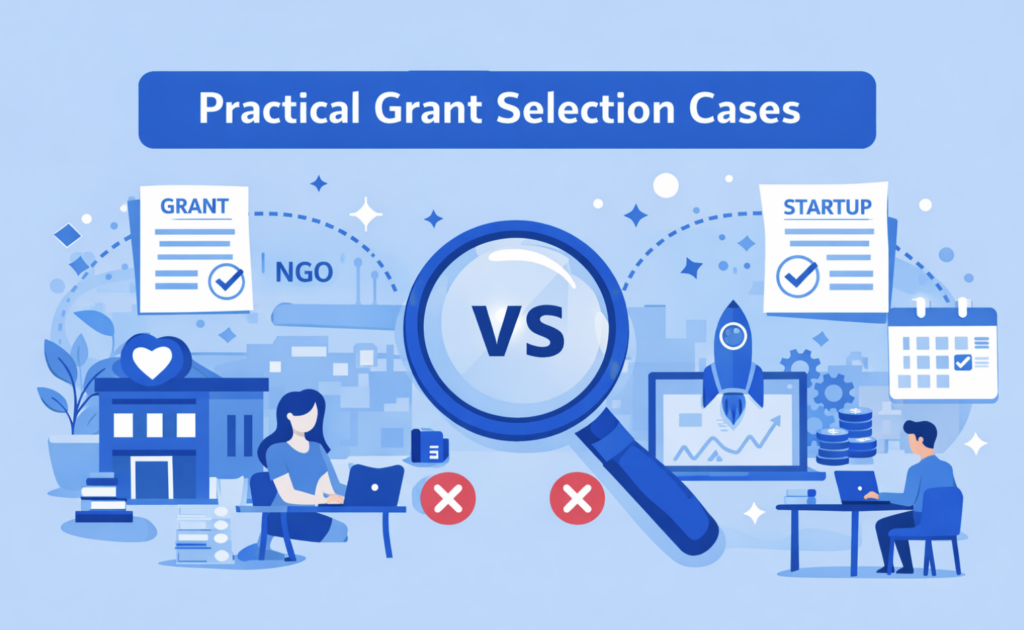
Practical grant selection case studies
Now let’s look at two hypothetical examples of how these criteria work in practice, one for an NGO and one for a small business or startup.
Case 1: NGO
An international charitable organization “EcoLife” from Kyiv plans an environmental education project for schools. The team seeks a grant of about 20,000 dollars per year to implement the project. During the search, they find three potential options:
• Grant A from an environmental protection foundation, international, up to 50,000 dollars for eco projects, deadline in 3 months.
• Grant B from a local business partner, up to 10,000 dollars, only for communities in Kyiv region, theme is community development.
• Grant C from an EU program, up to 100,000 euros, ecology plus participation of 3 partners from different EU countries, with 30% co-financing.
Analysis: All three grants allow a Ukrainian NGO to apply, but other criteria differ significantly. Grant A matches the project almost perfectly: environmental topic, sufficient budget, comfortable deadline, and standard requirements. Grant B is local and easy to apply for; however, it focuses on a different theme and has a small maximum budget that does not cover all needs. Meanwhile, Grant C requires elements EcoLife does not have right now: EU partners and 30% co-financing, plus complex international reporting. For a small NGO, that level of complexity is too high.
Conclusion: EcoLife decides to focus on Grant A as the best match across all criteria. The team keeps Grant B as a backup option because it is simpler, even though it offers less money and a different theme. The team removes Grant C immediately because it fails key requirements, including partners, co-financing, and capacity for that program level.
Case 2: Business or startup
An entrepreneur named Ivan runs a small agritech startup. He seeks grant funding to develop a prototype device. After reviewing available support programs, Ivan identifies two options:
• Grant X, a national business support program “eRobota”, up to 250,000 UAH, no personal contribution required, aimed at creating jobs.
• Grant Y, an international donor competition for innovation in the agri sector, up to 30,000 dollars, for registered businesses, with 50% co-financing.
Analysis: Both grants are available to Ukrainian businesses, but Grant X looks far more realistic. It does not require co-financing and sets moderate conditions, so Ivan only needs to create 2 jobs and report after 6 months. The amount is smaller than the project needs; however, Ivan can adjust the scope and budget to fit. In contrast, Grant Y offers more money, yet it sets demanding requirements: annual revenue above 50,000 dollars, 50% matching funds, an English application, and two years of financial statements. For a young startup, those conditions remain out of reach, so the chances of success are minimal.
Conclusion: Ivan decides to apply for Grant X because it fits the startup profile and current capacity. Ivan cannot use Grant Y right now because he lacks co-financing and the required financial reporting, so he filters it out.

Checklist before submitting a grant application
So you have found your grant and you are working hard on the proposal. Before you click the final “Submit” button, go through this list and make sure you did not miss anything. This is a grant application checklist of 15 points that helps you run final quality control before submission:
-
Eligibility compliance. Confirm again that you meet all eligibility criteria: applicant type, country, topic, budget size, and more.
-
Careful reading of guidelines. Re-read the call instructions before submission. Make sure you met all specific requirements, including file format, structure, and length limits.
-
All sections completed. Check that every section in your application form or project document is complete. Do not leave empty fields or unfinished answers.
-
Clear budget. Calculate the budget correctly: totals match and do not exceed the limit. Include all co-financing sources, if required, and use the correct currency.
-
Documents and annexes. Collect all required annexes, such as registration documents, financial statements, team CVs, and support letters, according to the call requirements.
-
Support letters. If partner support letters or recommendations are required, make sure they are signed and formatted properly. Therefore, prepare them early, not at the last minute.
-
Translation, if needed. If the application must be submitted in another language, for example English, check translation quality. Ideally, involve a native speaker or a professional editor.
-
Formatting requirements. Follow all formal rules: font, spacing, margins, page numbering, file formats, and file names, according to the guidelines.
-
Deadline discipline. Know the exact deadline date and time. Moreover, plan to submit at least one day in advance to avoid disruptions such as internet problems or portal issues.
-
Portal registration. If the call uses an online platform, register early and confirm access. In addition, learn how the submission system works, including uploads and e-signatures, so you do not lose time on the last day.
-
Alignment with objectives. Review the proposal and make sure it clearly shows how your project matches the grant program goals and donor priorities. This point matters most to evaluators.
-
Metrics and results. Present clear and realistic expected results: quantitative indicators, success measures, and beneficiary numbers. Also ensure consistency across the whole application.
-
Editing and proofreading. Check carefully for mistakes, typos, and ambiguous phrasing. Ideally, ask a colleague to review the application with fresh eyes.
-
Copy of the application. Save a full copy of everything you submit, such as an exported PDF or screenshots, plus all annexes. This will help you track outcomes and respond to donor questions.
-
Submission confirmation. After sending, make sure you receive confirmation, either by email or on screen, that the submission succeeded. Then save that confirmation in case any dispute arises.
FAQ (Frequently asked questions)
How can I find a grant for my project?
Start by monitoring specialized resources. Platforms such as GetGrant, EU Funding & Tenders Portal, and others let you search opportunities by criteria like sector, applicant type, and deadline. In addition, set up email alerts based on your profile so you do not miss new calls.
What does grant eligibility mean and why does it matter?
Eligibility refers to the compliance criteria a donor sets for applicants and projects. In simple terms, these are participation conditions: who can apply, from which countries, in which fields, and with what experience. Therefore, eligibility is the first thing to check when choosing a grant. If you fail even one key eligibility criterion, reviewers will not consider your application, and you will waste time on preparation.
Should I apply if I do not meet some grant requirements?
If the issue involves formal criteria, for example you are not the right organization type or you lack a mandatory partner, you should not apply because the application has no real chance. However, if the requirements are desirable rather than mandatory, for example experience in the sector or a strategic plan, you can apply if you compensate with other strong elements. As a general rule, choose grants where you match the ideal applicant profile as closely as possible, otherwise competitors will have an advantage.
In the end, a well-matched grant is half the success. Use tools like GetGrant to search for opportunities, analyze them with clear criteria, and prepare applications carefully. As a result, you increase your chances of securing funding and delivering your projects successfully.