Horizon Europe is the flagship framework programme of the European Union for research and innovation. It runs until 2027 and has a total budget of approximately €95 billion. The programme funds cutting-edge scientific and technological projects across all fields. These fields range from IT and biotechnology to green energy and healthcare.
Ukraine participates in Horizon Europe as an associated country. This status allows Ukrainian researchers, universities, startups, SMEs, and civil society organisations to take part in calls on equal terms with applicants from EU Member States. Participation in the programme gives Ukrainian teams access to substantial grant funding. It also opens the door to European expertise, new markets, and partnerships with leading institutions across Europe. You can learn more about the programme in our article “Horizon Europe Funding Programme: Europe’s Ambitious Initiative to Shape the Future.”
The new 2026–2027 work programme: priorities and funding
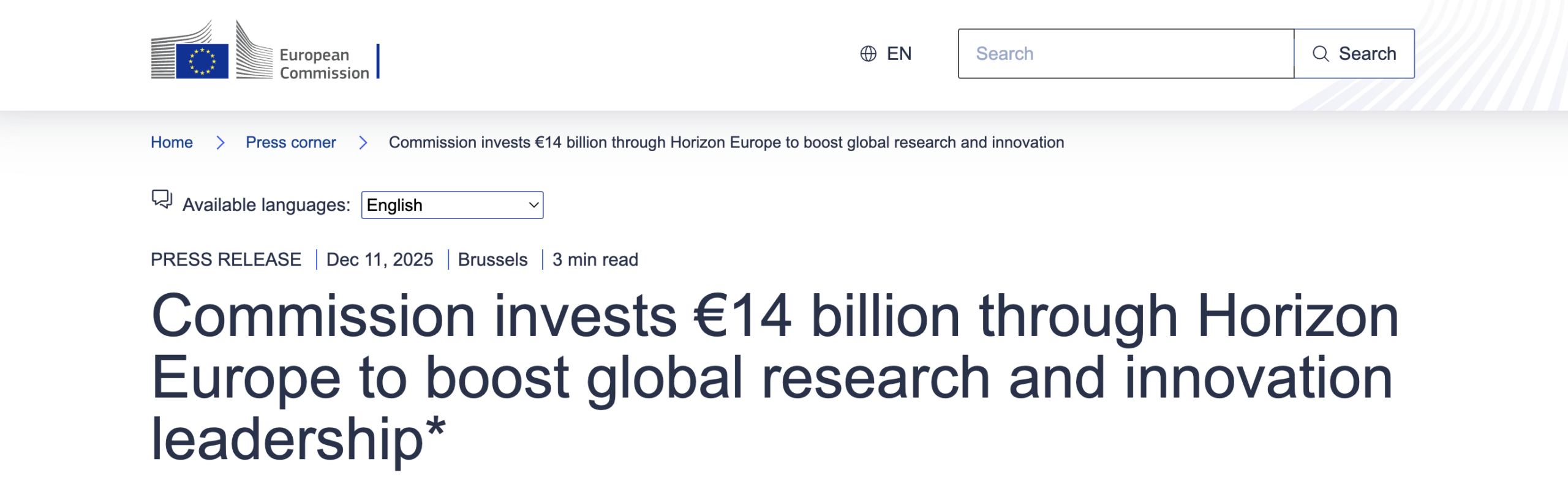
The European Commission has approved the new Horizon Europe work programme for 2026–2027. This programme represents the final stage of the seven-year cycle. Its total budget amounts to €14 billion. The EU will direct these funds towards accelerating research and innovation across Europe.
The new programme reflects the EU’s long-term strategic priorities. It focuses on climate neutrality, trustworthy artificial intelligence, and sustainable urban development. It also aims to strengthen innovation ecosystems in all European regions.
Key priorities of the 2026–2027 programme include:
Tackling climate change and industrial decarbonisation.
The programme directs significant investments towards achieving climate neutrality. The EU has allocated €540 million to the Clean Industrial Deal. This initiative supports the decarbonisation of energy-intensive industries and the deployment of clean technologies. It will accelerate the market uptake of renewable energy innovations and help reduce industrial emissions.
Development of artificial intelligence (AI).
The programme allocates €90 million to support safe and ethical AI applications in science. One of the key calls, AI for Science, promotes the integration of AI in materials science, agriculture, healthcare, and other sectors. Through this focus, the EU aims to strengthen its leadership in advanced and trustworthy AI.
Clean technologies and the green economy.
Horizon Europe actively supports the scaling up of environmentally friendly technologies. Funding under the Clean Industrial Deal helps companies implement innovations that decarbonise production processes. These efforts directly contribute to the EU’s climate goals. The supported projects are expected to deliver competitive green tech solutions for energy-intensive sectors.
Innovative architecture and spatial development.
The EU will allocate more than €210 million to the New European Bauhaus initiative. This initiative supports interdisciplinary projects that transform urban environments. It promotes sustainable and inclusive spaces. These range from energy-efficient architecture to neighbourhood regeneration based on accessibility and social cohesion. By combining design, ecology, and technology, the initiative aims to improve the quality of life in European cities.
Support for scientific talent.
The programme expands the Choose Europe initiative to attract leading researchers from around the world. The EU has allocated €50 million to Marie Skłodowska-Curie Actions. These funds support long-term research fellowships and mobility opportunities. They create new career paths for early-stage researchers and postdoctoral fellows in Europe. In addition, the programme invests another €50 million in research infrastructures. This investment improves access to advanced equipment and laboratories.
Strengthening regional innovation ecosystems.
Horizon Europe seeks to reduce disparities between countries and regions. To achieve this goal, it funds initiatives that support research and entrepreneurship at the regional level. The EU has allocated €240 million to the ERA Chairs scheme. This scheme attracts leading scientists to universities and research institutions in regions with developing innovation ecosystems. The programme also plans to establish European Startup and Scaleup Hubs. These hubs will strengthen cooperation between research institutions and businesses. Together, these measures aim to balance innovation geographically and close the gap between research centres and peripheral regions.
Simplified participation: what will change for applicants?
The new Horizon Europe work programme responds directly to feedback from researchers and innovators. It introduces substantial changes to participation rules. Application procedures will become simpler, faster, and more accessible, especially for newcomers.
Reduced bureaucracy.
The 2026–2027 work programme is 33% shorter than the previous 2023–2024 cycle. It focuses on fewer but larger projects. The programme will apply the lump sum funding model more widely. These fixed-amount grants will cover around half of all calls. This approach significantly reduces paperwork and financial reporting. Beneficiaries will report on achieved results rather than detailed cost breakdowns.
Two-stage application process.
The programme will apply a two-stage evaluation procedure to 41 calls. At the first stage, applicants submit a short project concept. This concept usually consists of only a few pages. Only teams with successful concepts will proceed to the second stage and submit a full proposal. This approach reduces time and resource costs. It especially benefits small organisations and newcomers.
Topics for newcomers and SMEs.
The programme introduces calls specifically designed for young teams, new organisations, and small and medium-sized enterprises. These calls feature simplified requirements and lower entry barriers. They give first-time applicants a better chance to succeed. As a result, Horizon Europe becomes more accessible to Ukrainian innovators without prior experience in the programme.
More transparent evaluation and faster results.
The European Commission plans to introduce anonymised proposal evaluations in selected calls. It will also simplify application templates. These measures aim to reduce bias and speed up decision-making. The Commission also expects to shorten the time-to-grant. This change will allow successful projects to receive funding more quickly.
These updates aim to make Horizon Europe more inclusive. They particularly support smaller organisations and first-time applicants. As Ekaterina Zaharieva, European Commissioner for Startups, Research and Innovation, emphasised: “We have listened to researchers and innovators and made Horizon Europe simpler and more accessible to SMEs, start-ups and newcomers. We are also expanding Choose Europe to make our continent even more attractive to researchers and innovators worldwide.” This statement highlights the EU’s commitment to reform and openness. Europe seeks to position itself as a global hub for talent and innovation.
Advice for Ukrainian applicants
The Horizon Europe 2026–2027 programme offers significant opportunities for Ukraine. At the same time, competition for grants remains intense. Ukrainian teams should consider several key recommendations.
Prepare in advance.
Many 2026 calls will appear soon. Teams should start preparing project proposals early. Build consortia with European partners. Develop project ideas and budgets well before official call launches. Early planning and proactive partner searches significantly increase success rates.
Stay informed.
The EU publishes all calls and programme documents on the Funding & Tenders Portal. Applicants should monitor this platform regularly. Information webinars organised by the European Commission also provide valuable insights. Subscribing to updates from grant support services, such as GetGrant, helps teams stay informed.
Take advantage of the new rules.
The 2026–2027 calls introduce lump sum funding, two-stage applications, and reduced reporting. Applicants should carefully review each call’s conditions. Some calls may require only a total budget figure. Others may start with a short concept note. These changes reduce administrative burden and improve access for newcomers. Teams should use newcomer-oriented topics to enter Horizon Europe with lower competition.
Finally, Horizon Europe offers more than funding. It enables integration into the European research and innovation community. Participation helps Ukrainian teams gain international visibility. It also provides valuable collaboration experience and supports joint solutions to global challenges. The 2026–2027 programme therefore offers Ukraine a real opportunity to strengthen its role in European research and innovation networks. Preparation should begin now to ensure strong and timely applications.
For more practical guidance, see our dedicated article on successful proposal preparation for Horizon Europe.
We wish Ukrainian applicants every success in reaching new horizons with Horizon Europe.